The Real Risk of Running “Good Enough” Bearings
In many CNC operations, spindle bearings are replaced only when they fail. If the machine is still holding tolerance and production is moving, the spindle is often considered “fine.” For maintenance managers balancing uptime, labor, and budgets, that approach can seem practical.
However, spindle bearings rarely move from healthy to catastrophic overnight. They degrade gradually, and the period between optimal performance and visible failure is where profitability quietly slips away.
This is the danger of running bearings in the “good enough” zone.
Bearings Degrade Long Before They Fail
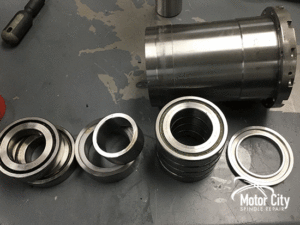
Spindle bearings are precision components operating under high speed, load, and thermal stress. Over time, microscopic surface fatigue begins to develop. Lubrication characteristics shift. Internal clearances change. Preload settles or degrades.
None of these changes may immediately trigger an alarm. The machine may still run parts within tolerance. But internally, the system is no longer operating at peak stiffness or thermal stability.
For maintenance managers, the objective is not simply avoiding failure. It is preserving predictable performance.
What Happens When Bearings Move Past Optimal Performance
As bearings begin to wear, several performance variables shift subtly but meaningfully.
Micro-pitting forms on rolling elements and raceways due to cyclic stress. At first, this only causes slight increases in vibration. Over time, it accelerates fatigue and reduces overall bearing life.
Preload degradation is another common issue. Spindle bearings rely on precise preload to maintain rigidity. As wear occurs, stiffness declines. Reduced rigidity can lead to increased runout, chatter during aggressive cuts, and inconsistent surface finishes. Even small losses in stiffness can compound in high-speed or tight-tolerance applications.
Heat generation also becomes more pronounced as friction increases. Elevated temperatures affect shaft growth and internal clearances, leading to thermal instability during long production runs. Dimensional drift and tolerance variation often trace back to this gradual thermal imbalance.
In many cases, the taper interface begins to suffer as well. Changes in shaft dynamics place additional stress on the tool holder connection, increasing the risk of fretting, taper wear, and premature tool failure.
These issues rarely present as dramatic machine faults. Instead, they appear as declining tool life, unexplained scrap, slower cutting parameters, or increased operator complaints.
The Financial Cost of “Almost Failure”
Running bearings until they fail may appear to save money, but the hidden costs often outweigh the perceived savings.
As bearing condition declines, tool consumption typically increases. Cutting speeds may need to be reduced to maintain finish quality. Scrap rates can rise incrementally. Operators spend more time adjusting offsets and compensating for inconsistencies.
When failure eventually occurs, it often results in emergency repair logistics, expedited freight, and unplanned downtime during peak production. Overtime labor and schedule disruptions follow.
A planned rebuild during scheduled downtime is predictable and manageable. An unexpected spindle failure rarely is.
For maintenance managers, predictability is as valuable as cost control. Planned interventions protect both.
The Role of Condition-Based Monitoring
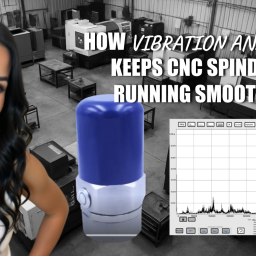
Modern vibration analysis and spindle testing technologies allow maintenance teams to detect bearing degradation long before catastrophic failure.
Rather than waiting for audible noise or excessive heat, vibration trends can reveal defect frequencies associated with early-stage fatigue. Thermal performance testing can identify abnormal growth patterns. Runout measurement can confirm stiffness loss.
This data-driven approach allows maintenance leaders to schedule rebuilds strategically, aligning service with production windows and capital planning.
It transforms spindle management from reactive replacement to controlled lifecycle planning.
Protecting Uptime Through Proactive Strategy
The difference between reactive and proactive maintenance is not simply timing. It is control.
When bearings are serviced before entering the “good enough” decline zone, production remains stable. Surface finishes stay consistent. Tool life remains predictable. Cycle times are not quietly extended to compensate for instability.
Maintenance managers who adopt condition-based strategies often find that overall spindle lifecycle costs decrease, even though rebuilds may occur before visible failure.
The goal is not squeezing the last hour out of a bearing. The goal is protecting the production schedule.
Why Maintenance Managers Trust Motor City Spindle Repair
When it comes time to rebuild a spindle, the quality of the rebuild determines how long the spindle will perform at optimal levels. Bearing selection, preload accuracy, grinding tolerances, balancing precision, and final testing all directly impact long-term reliability.
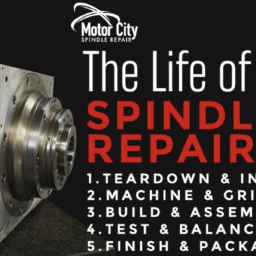
Motor City Spindle Repair has built its reputation on controlled, performance-verified rebuilds. Each spindle undergoes complete disassembly and inspection. Critical components are evaluated for wear and dimensional integrity. Bearings are installed with precise preload specifications designed to restore original stiffness and performance.
After assembly, spindles are dynamically balanced and run-tested to verify vibration levels and thermal behavior at operating speed. Performance is confirmed before the spindle is returned to the customer. If a unit cannot be properly tested, it is not rebuilt. That standard protects maintenance teams from repeat failures and short-term fixes.
With in-house grinding, balancing, and comprehensive testing capabilities, Motor City provides repair solutions designed for durability and predictability, not temporary restoration.
For maintenance managers responsible for uptime, budget accountability, and production reliability, partnering with a repair facility that validates performance before delivery reduces risk and increases confidence.
Final Thought
A spindle does not have to fail catastrophically to cost you money. Bearings that are technically still running may already be affecting rigidity, thermal stability, and tool performance.
The critical question is not whether the spindle still turns. It is whether it is still operating at its optimal performance window.
Proactive evaluation and strategic rebuild planning protect uptime, production quality, and long-term cost control. If your team is looking to assess spindle condition or implement a more predictive maintenance approach, Motor City Spindle Repair is ready to help you move from reactive response to controlled performance management.

CONTACT US ANYTIME IF YOU would LIKE TO CHAT WITH OUR EXPERTS OR STOP BY OUR 25,000 SF MANUFACTURING FACILITY LOCATED IN DEARBORN, MICHIGAN!
(734) 261-8600 OR EMAIL US AT SALES@MOTORCITYREPAIR.COM
Need a FREE ESTIMATE? Click HERE

To view our most recent blog post, click HERE