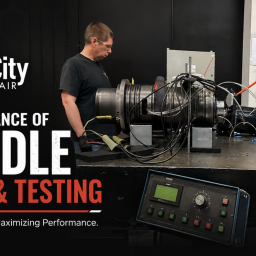
Why CNC Spindle Testing is important
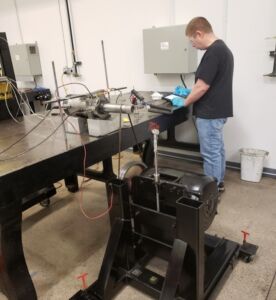 In most shops, a spindle rebuild is treated as the finish line. The unit is repaired, installed, and expected to perform. But for maintenance managers responsible for uptime, that is not where confidence should come from.
The real question is not whether a spindle was rebuilt. The real question is whether it was proven to perform before it ever went back into your machine.
That is where testing changes everything.
A Rebuild Without Testing Is Still an Unknown
A spindle can look perfect on the outside and still have problems internally. Bearings can be installed correctly but not seated under real operating conditions. Preload can be set during assembly but behave differently once the spindle reaches speed and temperature.
Without testing, those variables remain unknown.
When a spindle is put back into production without being run, monitored, and validated, the risk does not disappear. It simply gets transferred from the repair facility to your shop floor.
For a maintenance manager, that means uncertainty at the exact moment you need reliability.
Real Operating Conditions Reveal What Assembly Cannot
There is a major difference between assembling a spindle and running a spindle.
During testing, the spindle is brought up to speed, cycled through operating ranges, and monitored for vibration, temperature, and overall performance. This is where hidden issues show themselves.
Small imbalances that were not noticeable during assembly become obvious at speed. Thermal growth can affect clearances and preload. Minor inconsistencies in components or assembly begin to show patterns that would never be visible otherwise.
Testing is where theory meets reality. It is the only way to confirm that the spindle performs the way it should under the conditions it will actually face in your machine.
Vibration Does Not Lie
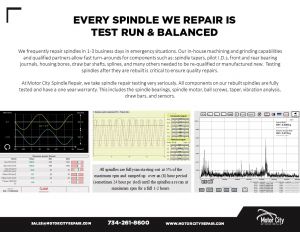
One of the most important parts of spindle testing is vibration analysis. It provides a clear picture of what is happening inside the spindle without needing to take it apart again.
Vibration patterns can indicate imbalance, bearing defects, misalignment, and other internal issues that are impossible to detect visually. These patterns give insight into both immediate performance and long-term reliability.
For maintenance managers, this data is not just helpful. It is critical. It allows you to make informed decisions instead of relying on assumptions.
Balancing Is Only Proven When It Is Verified
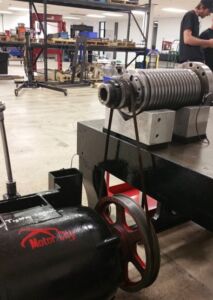 Balancing is often mentioned in spindle repair, but it only matters if it is validated under operating conditions.
A spindle that is not properly balanced will generate unnecessary vibration, increase heat, and accelerate wear on internal components. Over time, this leads to reduced lifespan and more frequent failures.
Testing confirms that balancing was done correctly. It ensures that the spindle runs smoothly at speed and does not introduce additional stress into the machine.
Without that verification, balancing is just a claim.
The First Hours Back in Production Are the Most Critical
The initial run time after a spindle is installed is where many problems surface. If a spindle has not been properly tested beforehand, your machine becomes the testing environment.
That is a risk most operations cannot afford.
Unexpected vibration, temperature spikes, or performance issues during startup can lead to immediate downtime. In some cases, it can cause secondary damage that puts the machine back out of service again.
Proper testing removes that risk by identifying and resolving issues before the spindle ever leaves the repair facility.
Testing Protects More Than the Spindle
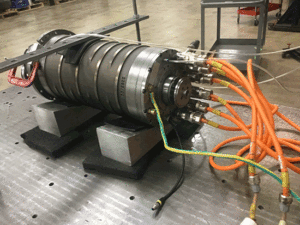
A spindle does not operate on its own. It is part of a larger system, and its performance directly affects the rest of the machine.
When a spindle is not properly tested, it can introduce vibration, instability, and inconsistency into the system. This impacts tool life, part quality, and overall machine health.
For maintenance managers, this means more than just a spindle problem. It becomes a production problem.
Testing ensures that the spindle is not just functional, but stable and reliable within the system it will be placed back into.
Why Maintenance Managers Trust Motor City Spindle
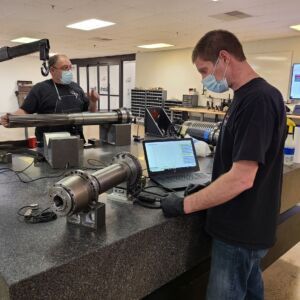
Maintenance managers trust Motor City Spindle because testing is not treated as an extra step. It is a requirement.
Every spindle is run, monitored, and evaluated before it is considered complete. Vibration analysis, balancing verification, and controlled run-in procedures are part of the process, not an afterthought. This ensures that performance is proven, not assumed.
Just as important, each spindle goes through a detailed inspection and failure analysis to understand why it failed in the first place. This approach helps prevent repeat issues and gives maintenance teams more insight into their equipment.
The standard is simple. If a spindle cannot be tested, it should not be rebuilt.
For maintenance managers, that means fewer surprises, less risk during startup, and more confidence when putting a spindle back into production.
Final Thought
A rebuild restores a spindle. Testing proves it.
For maintenance managers, that distinction matters. Because at the end of the day, it is not about whether the spindle was repaired. It is about whether it will perform when production depends on it.
And the only way to know that for sure is to test it before it ever goes back into your machine.

CONTACT US ANYTIME IF YOU would LIKE TO CHAT WITH OUR EXPERTS OR STOP BY OUR 25,000 SF MANUFACTURING FACILITY LOCATED IN DEARBORN, MICHIGAN!
(734) 261-8600 OR EMAIL US AT SALES@MOTORCITYREPAIR.COM
Need a FREE ESTIMATE? Click HERE

To view our most recent blog post, click HERE