CNC Manufacturing in Aerospace: Why Spindle Health Matters to Maintenance Managers
 Aerospace manufacturing leaves little room for inconsistent machining. Whether a shop produces structural components, engine parts, or landing gear components, its CNC equipment must deliver the accuracy and repeatability required by each job.
For maintenance managers, keeping that equipment reliable means looking beyond whether a machine is running. A spindle can continue turning while changes in vibration, temperature, or toolholding begin affecting production. Recognizing those changes early can help protect expensive parts and give maintenance teams more control over repair scheduling.
Aerospace Materials Put Different Demands on CNC Equipment
Aerospace machining involves a wide range of materials, including aluminum, titanium, and nickel alloys. Each requires a different approach to cutting speeds, tooling, cooling, and machine loading.
Titanium presents particular challenges because heat generated during cutting can concentrate near the cutting edge and accelerate tool wear. Research published through NASA describes the relationship between titanium’s low thermal conductivity, high tool temperatures, and wear. For maintenance managers, this makes it especially important to understand the application before interpreting changes in machine performance.
A spindle used for high-speed aluminum machining may operate under very different conditions from one used for demanding titanium cuts. Maintenance decisions should reflect the spindle design, manufacturer’s requirements, and actual operating conditions.
Spindle Problems Can Show Up in Part Quality First
A spindle does not have to fail completely to create problems on the production floor. Changes in bearing condition, taper condition, tool retention, or spindle runout can contribute to inconsistent cutting performance.
Operators may notice chatter, a changing surface finish, or tools that no longer last as long as expected. Quality personnel may see dimensional variation that becomes more noticeable as the machine warms up.
These symptoms do not automatically mean the spindle needs a rebuild. Tooling, workholding, programming, and other machine components can produce similar problems. The maintenance team’s job is to investigate the complete process and identify what changed before deciding on a repair.
When operators repeatedly reduce feeds or adjust offsets to keep a familiar job running, those adjustments deserve attention. They may be compensating for a developing problem.
Monitor Trends Before They Become Production Interruptions
Useful condition monitoring starts with knowing how a healthy machine behaves. Vibration, temperature, noise, and lubrication condition are established indicators used in bearing maintenance. Tracking them over time can help maintenance teams recognize changes that deserve further investigation.
Measurements are most useful when taken under comparable conditions. A temperature reading after a demanding cut cannot be directly compared with one taken during an unloaded warmup. Recording spindle speed, operating time, and load alongside readings helps make the information more meaningful.
Operator observations belong in that record as well. A new sound at a certain speed or a finish problem that appears only after several hours can help narrow the investigation.
Follow the equipment manufacturer’s limits and procedures when evaluating abnormal conditions. Monitoring should support timely action when a machine shows signs of trouble.
Protect the Systems That Support the Spindle
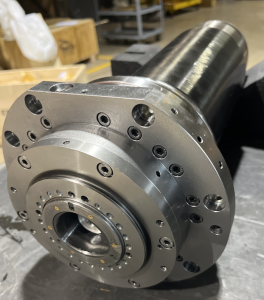 Spindle reliability also depends on the systems surrounding it. Lubrication delivery, cooling, sealing, and toolholding all deserve attention during preventive maintenance.
A lubrication system may contain oil without delivering the correct amount to the bearings. A cooling system may run while a restriction or temperature-control problem reduces its effectiveness. Contamination or damage at the spindle taper can interfere with proper tool seating.
Maintenance teams should verify these systems according to the machine manufacturer’s procedures. Finding and correcting a supporting-system problem is especially important before reinstalling a rebuilt spindle. Otherwise, the repaired assembly may return to the same conditions that contributed to its original damage.
Plan for the Full Cost of Downtime
In aerospace machining, a spindle failure can interrupt more than one operation. A partially completed component may already represent substantial material cost and machining time. An unexpected shutdown can also affect inspection schedules, downstream operations, and delivery commitments.
Maintenance managers should identify which machines create the greatest production risk if they go down. That assessment can help guide spare-spindle decisions, planned repair windows, and conversations with a rebuild provider before an emergency occurs.
Keeping spindle identification, service history, alarm records, and removal information accessible can also reduce delays when a repair becomes necessary.
A Rebuild Should Address More Than Damaged Bearings
Replacing damaged bearings is only part of evaluating a spindle. Bearing seats, shaft and housing condition, lubrication passages, sealing, and other applicable components may also require inspection.
The operating history matters. A recent crash, contamination event, lubrication alarm, or gradual increase in vibration can provide valuable context for the teardown findings.
After assembly, testing helps evaluate spindle operation before it returns to the customer. Maintenance managers should discuss the available testing and documentation with their repair provider. Once the spindle is reinstalled, the machine still needs the appropriate checks and production qualification required by the facility’s procedures.
Why Maintenance Managers Should Trust Motor City Spindle Repair With Their Rebuilds
 Maintenance managers need a repair partner who understands that a spindle problem affects production schedules, part quality, and the people responsible for keeping machines available.
At Motor City Spindle Repair, our technicians evaluate spindle condition and inspect components to determine what the rebuild requires. Our testing process includes evaluating vibration, temperature, and spindle operation before the unit heads back to your facility.
We offer free evaluations so your team can understand the recommended repair scope before moving forward. Emergency repair services are also available when an unexpected failure puts production at risk.
Our one-year in-service warranty provides additional support when your rebuilt spindle returns to operation. Sharing your machine’s symptoms, application, and operating history helps our team better understand the concerns behind the repair.
If your aerospace machining operation is experiencing spindle problems or planning an upcoming rebuild, contact sales@motorcityrepair.com for a free evaluation. Let’s help your maintenance team make an informed repair decision and get your equipment ready to return to production.
CONTACT US ANYTIME IF YOU would LIKE TO CHAT WITH OUR EXPERTS OR STOP BY OUR 25,000 SF MANUFACTURING FACILITY LOCATED IN DEARBORN, MICHIGAN!
(734) 261-8600 OR EMAIL US AT SALES@MOTORCITYREPAIR.COM
Need a FREE ESTIMATE? Click HERE

To view our most recent blog post, click HERE