Why Spindle Bearing Preload Matters: How Too Much or Too Little Affects Spindle Performance
For maintenance managers, spindle reliability directly affects production schedules, part quality, and operating costs. When a spindle begins running hot, producing unusual vibration, or losing accuracy, bearing preload may be one of the contributing factors.
Spindle bearing preload is carefully engineered to give the spindle the rigidity and precision it needs to operate correctly. Too much or too little preload can shorten bearing life, damage spindle components, and lead to unexpected downtime. Understanding its role can help maintenance managers recognize potential problems earlier and make better repair decisions.
What Is Spindle Bearing Preload?
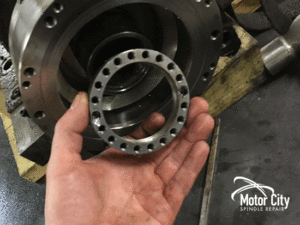
Bearing preload is a controlled internal force applied to a bearing set during assembly. This force removes internal clearance between the rolling elements and raceways before the spindle is placed into operation.
In a precision spindle, preload helps create the stiffness needed to control radial and axial movement. It also allows the bearings to respond more consistently to cutting forces, speed changes, and thermal conditions.
Preload is not simply a matter of tightening the bearings as much as possible. The correct amount depends on the spindle design, bearing arrangement, contact angle, operating speed, lubrication system, expected cutting loads, and temperature range.
Why Preload Is Critical to Spindle Performance
A properly preloaded bearing set supports accurate rotation while maintaining the rigidity required for machining. When the preload is correct, the spindle can better resist movement under load and maintain consistent tool position.
This contributes to improved surface finishes, dimensional accuracy, and repeatability. Proper preload can also help control vibration and allow the spindle to operate more smoothly throughout its intended speed range.
The challenge is that preload must remain within an acceptable range as the spindle reaches operating temperature. Components expand as heat develops, which can change the forces acting on the bearings. A spindle that appears acceptable when cold may behave very differently after it has been running.
What Happens When Bearing Preload Is Too High?
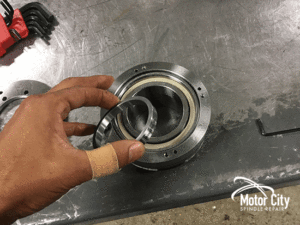
Excessive preload increases the contact force between the rolling elements and bearing raceways. This creates more friction and causes the spindle to generate additional heat.
A spindle with too much preload may show a rapid temperature increase during run-in or normal operation. It may also draw more motor current, struggle to reach its intended speed, or produce abnormal vibration readings.
The additional heat can reduce lubricant life and change internal bearing clearances. As temperatures continue to rise, thermal expansion can increase the load on the bearing set even further. This can create a cycle in which increased preload creates heat, and the heat creates even more internal loading.
If the condition continues, the bearings may experience smearing, surface distress, cage damage, lubricant breakdown, or premature fatigue. In severe cases, the bearing set can seize and cause extensive damage to the spindle shaft, housing, or other internal components.
For maintenance managers, a spindle that consistently runs hotter than expected should never be ignored. Temperature alone does not prove that preload is incorrect, but it is an important warning sign that deserves further evaluation.
What Happens When Bearing Preload Is Too Low?
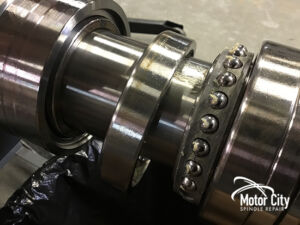
Insufficient preload creates a different set of problems. When a bearing set does not have enough preload, the spindle may lack the rigidity required to control movement during machining.
This can contribute to chatter, vibration, poor surface finishes, inconsistent dimensions, and shortened tool life. The spindle may appear to run normally without a cutting load but lose stability once it begins machining.
Too little preload can also allow the rolling elements to skid rather than roll correctly, especially during rapid acceleration or high-speed operation. Skidding can damage the raceways and create wear patterns that eventually lead to bearing failure.
In some cases, insufficient preload can create internal looseness that is mistaken for another machine problem. Maintenance teams may spend time checking tooling, fixtures, machine alignment, or cutting parameters before realizing the spindle is contributing to the issue.
How Speed and Temperature Affect Preload
Spindle preload is not constant under every operating condition. Centrifugal forces, component expansion, lubrication behavior, and heat generation can all affect the bearing set as speed increases.
High-speed spindles require careful consideration because the rolling elements generate greater centrifugal forces. The spindle shaft, bearing inner rings, housing, and bearing outer rings may also expand at different rates. These changes can alter the operating preload.
This is why replacing a bearing with one that appears physically similar is not enough. The replacement must meet the correct specifications for precision class, contact angle, preload, internal geometry, lubrication, and speed capability.
A bearing that fits the shaft and housing can still be completely wrong for the application.
Bearing Arrangement Also Matters
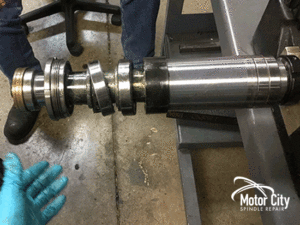 Precision spindle bearings are often installed in matched arrangements designed to manage radial and axial loads. Common arrangements include back-to-back, face-to-face, and tandem configurations.
Each arrangement behaves differently under load. Back-to-back arrangements generally provide greater moment rigidity, while face-to-face arrangements can accommodate certain alignment conditions differently. Tandem arrangements are used when multiple bearings must support axial load in the same direction.
The arrangement specified by the spindle manufacturer should not be changed without a complete engineering review. Changing the bearing orientation or substituting a different matched set can alter the spindle’s rigidity, thermal behavior, and load capacity.
Matching marks and orientation markings must also be followed during assembly. Precision bearings can have the correct part numbers and still perform poorly if they are installed in the wrong direction or sequence.
Warning Signs Maintenance Managers Should Watch For
Incorrect preload does not always cause an immediate failure. The spindle may continue operating while performance gradually declines.
Maintenance managers should pay attention to unexplained increases in spindle temperature, vibration, noise, motor load, tool wear, or cycle time. Changes in surface finish, repeatability, and part dimensions may also indicate that spindle rigidity is deteriorating.
It is helpful to compare current operating data with the spindle’s normal baseline. A gradual change can be more significant than a single reading that falls outside a general guideline.
If a spindle runs hotter, louder, or less accurately than it did previously, the condition should be documented and investigated before a complete failure interrupts production.
Why Preload Cannot Be Confirmed by Feel Alone
Precision spindle assembly requires more than rotating the shaft by hand and deciding whether it feels smooth. A spindle can feel acceptable at low speed while developing excessive heat or vibration at operating speed.
Proper rebuilding requires controlled assembly procedures, accurate measurements, appropriate tooling, and documented testing. Run-in testing allows technicians to monitor temperature, vibration, and performance as spindle speed gradually increases.
The spindle must also be evaluated as a complete system. Bearing condition, fits, lubrication, spacers, shaft geometry, housing geometry, balance, and assembly practices all influence the final result.
This is one reason spindle bearing replacement should not be treated as a basic mechanical repair. Installing premium bearings will not correct an underlying problem with the shaft, housing, spacers, lubrication system, or original failure condition.
Documenting the Original Failure Is Important
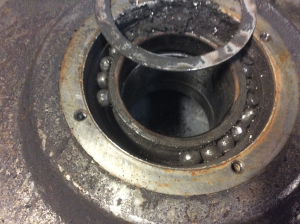
Before replacing a bearing set, the cause of the original failure should be investigated. If the spindle failed because of contamination, lubrication problems, a crash, incorrect installation, or excessive operating temperature, simply installing new bearings may allow the same failure to happen again.
A detailed evaluation can reveal damage patterns that provide clues about what occurred. Discoloration may indicate excessive heat. Surface distress can point to lubrication issues. Fretting, false brinelling, electrical damage, contamination, or abnormal raceway patterns can each suggest different operating conditions.
Maintenance managers should ask whether the repair provider documents these findings and explains the likely cause of failure. This information can help the plant correct external problems and reduce the chance of another unplanned shutdown.
The Importance of Proper Run-In and Testing
After a spindle is rebuilt, it should be gradually brought through its operating speed range under controlled conditions. This allows the bearings and lubricant to stabilize while technicians monitor heat generation, vibration, and overall performance.
Immediately running a newly rebuilt spindle at maximum speed can create unnecessary risk, particularly with grease-lubricated bearings. A controlled run-in process helps distribute the grease and prevents excessive churning, which can generate heat.
Testing should be appropriate for the specific spindle. Temperature and vibration results should be evaluated throughout the speed range rather than at only one low-speed operating point.
For maintenance managers, this testing provides confidence that the spindle is performing properly before it is returned to production.
Why Maintenance Managers Should Trust Motor City Spindle Repair
Motor City Spindle Repair understands that a successful rebuild requires more than replacing damaged bearings. Our technicians evaluate the complete spindle assembly to identify wear, damage, and conditions that may have contributed to the original failure.
Bearing selection and installation are handled with careful attention to precision class, preload, contact angle, orientation, lubrication, fits, and the spindle’s operating requirements. Components are inspected and measured so that new bearings are not installed into a spindle with unresolved shaft, housing, spacer, or balance issues.
We also believe a spindle must be properly tested before it returns to your facility. Our philosophy is simple: if we cannot test it, we will not rebuild it. Spindles are run through controlled testing procedures so our team can monitor temperature, vibration, and operating performance before shipment.
Maintenance managers also receive the support of a company with real spindle rebuilding experience and access to a large worldwide inventory of premium spindle bearings. This combination helps us identify the correct bearings, respond quickly, and provide technical guidance based on how those bearings perform inside an actual spindle.
When production depends on spindle reliability, you need a repair partner that understands the relationship between bearing preload, thermal behavior, vibration, lubrication, and machining performance. Motor City Spindle Repair provides the technical experience, testing capabilities, and attention to detail needed to return your spindle to service with confidence.

CONTACT US ANYTIME IF YOU would LIKE TO CHAT WITH OUR EXPERTS OR STOP BY OUR 25,000 SF MANUFACTURING FACILITY LOCATED IN DEARBORN, MICHIGAN!
(734) 261-8600 OR EMAIL US AT SALES@MOTORCITYREPAIR.COM
Need a FREE ESTIMATE? Click HERE

To view our most recent blog post, click HERE